Features
Melody and Chords on One Page
The tune goes on a single staff with chord symbols set above each bar, the way a fake book prints it. One page you can take in at a glance.
Chords Read From the Audio
Chord symbols come out of the recording itself rather than a guess at the key, so the chart follows the harmony the band actually played.
Print It or Pass It Around
Export a PDF for the music stand, or MusicXML for MuseScore, Sibelius, Finale, and Dorico when you want to adjust the chart first.
Example Transcriptions
Click on the cards to see Songscription in action.
One Staff, Chords on Top
Sheet Music
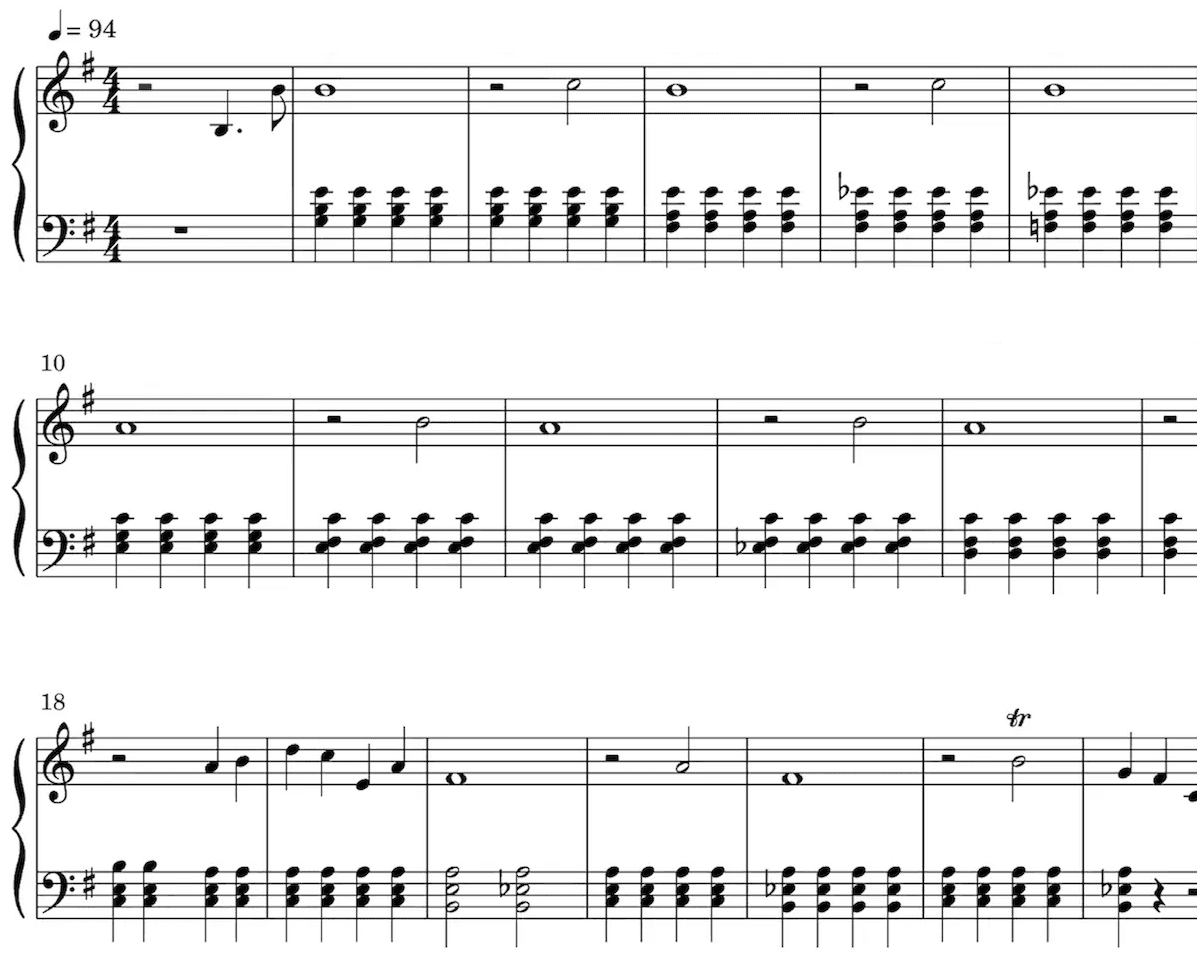
Our AI technology picks out the notes from your audio and intelligently notates them on a musical staff, automatically detecting a wide range of musical features including time and key signature, trills, staccato, and other expressive markings.
Sheet music is especially valuable for classically trained musicians, music students, music teachers, and composers.
Playback the score to hear the transcription.
Speed it up or slow it down to your liking.
Edit the transcription.
Loved by musicians worldwide
Join thousands of musicians who have transformed their creative process with Songscription
"There are so many songs I've wanted to play but could never find the sheet music for. Songscription finally solves that problem; now I can just run the audio through and start playing."

Tomer
"I've composed a song that has lived in my heart for years - a deeply personal piece that I've never been able to share properly. Thanks to Songscription, I've finally translated it into sheet music. Now my composition can be performed and appreciated beyond just my own playing - a dream I've had since I first wrote those notes."

Tony
"There are so many songs I've written throughout my life that I hold in my hands but have never been able to pass on. Songscription opened a new door. For the first time, I have a lasting time capsule of my song that anyone, anywhere, can play, now and far into the future."

"I create at the piano, and Songscription cleans up my mess into real sheet music."

Jeff

"Songscription has helped me transcribe my own live recordings, transforming a mundane & time-consuming task into something that has saved me countless hours."

Yameen Sekandari
As seen in...
Frequently Asked Questions
More questions? Contact us
How do I turn a song into a lead sheet?
Upload the recording to Songscription and pick Lead Sheet. The AI follows the melody and the harmony in the audio and writes the tune on one staff with chord symbols above it. Clips up to 30 seconds are free with no sign-up. Export the finished chart as PDF or MusicXML.
Does the chart include chord symbols?
Yes. They come from the recording itself, not from a guess at the key. The symbols are engraved as real harmony markings, so they arrive intact in MuseScore, Sibelius, Finale, and Dorico rather than as loose text you have to reposition.
Can I make a lead sheet from a YouTube link?
Yes. Paste the link and we pull the audio automatically. Instagram and TikTok links work the same way. You can also upload an mp3, WAV, M4A, or MP4 file, or record the song straight from your browser.
Can I change the key of the lead sheet?
Yes. Transpose the chart and the melody and the chord symbols move together, so the whole page lands in the new key. Singers do this constantly: drop the song a third and the band reads the new symbols without anyone rewriting the chart.
How do I make a lead sheet from a recording?
Upload the song and choose Lead Sheet. Songscription follows the melody through the recording and writes it on one staff, then sets a chord symbol above each change. A chart usually comes back in about a minute, and you never open notation software to get it.
- Add the recording. Drop in an mp3, wav, m4a, or mp4, paste a YouTube link, or record the song straight from your browser.
- Pick Lead Sheet. There is one output shape here, so there is no mode step to work through. Select it and the transcription starts.
- Read it or export it. Check the chart on screen, fix anything you want in the editor, then print a PDF or export MusicXML.
What is a lead sheet, and when do you want one?
A lead sheet is the skeleton of a song: the melody written on a single staff, with chord symbols above it naming the harmony. Nothing else is spelled out, which is the point. The player supplies the voicings, the groove, and the feel.
That makes it the right format whenever the arrangement changes from night to night. A trio reading the same chart can play it as a ballad or a shuffle, and nobody rewrites a part. New to chord symbols? Our guide on how to read chord symbols covers what the letters and extensions mean, and the chords guide covers how progressions fit together.
- Melody on one staff, so a singer or any melody instrument can read it
- Chord symbols above the bar for whoever is comping
- Short enough to sit on one or two pages instead of a full score
- Easy to transpose, because only the symbols and the tune move
Can I use these charts for worship or a jazz gig?
Yes, and those are the two places lead sheets earn their keep. A worship team that needs the same song in a different key every few weeks is far better served by a chart than by a fixed arrangement, and a jazz group reading heads wants the tune and the changes and nothing more.
Changing key is the usual reason. Run the chart through the transpose sheet music tool and the melody and the chord symbols move together, so the band reads one page in the new key. There is a walkthrough on transposing a song to fit your voice if you are picking a key for a singer.
We have written up both workflows: chord charts for worship songs covers building a set the band can follow, and getting a Nashville number chart from a song shows the number system many worship teams prefer to letter names.
What if I need more than the melody and the chords?
Pick a different output. A lead sheet is deliberately sparse, so when you want the whole texture written out, another tool on the site fits better.
- For a singer plus accompaniment, the piano and vocal arrangement keeps the sung line on its own staff over a two hand piano part
- For a solo piano version of the whole song, song to piano folds the melody into the piano writing
- For the literal notes of one instrument in the mix, the audio to notes converter transcribes that part directly
- For fretted instruments, the guitar tab generator writes tablature instead of notation